
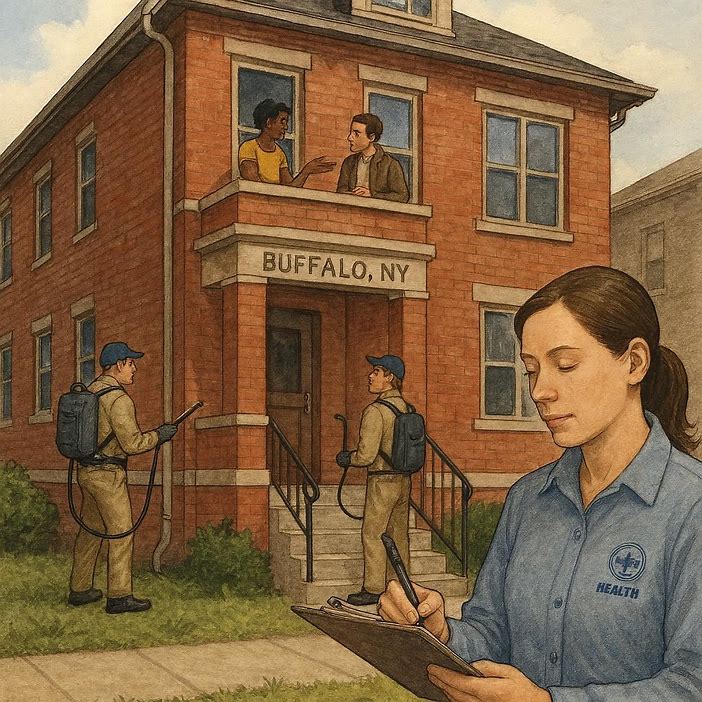
Bed bugs have reemerged across many urban housing districts in the United States, with public health agencies noting a steady rise in infestations over the past decade, especially in dense rental communities. Cities like Buffalo, New York, have seen recurring complaints in multi-unit housing, where pest movement between apartments makes control more complex than a single household issue.
In response to these challenges, services such as bed bug control Buffalo NY have become part of a broader conversation about who should carry responsibility for prevention and treatment. The issue is no longer limited to extermination alone, but extends into housing policy, tenant protection, and public health coordination. As U.S. Environmental Protection Agency (EPA) guidelines emphasize, bed bug management is most effective when coordinated across entire buildings rather than isolated units, yet implementation often depends on unclear responsibility lines between landlords and tenants.
The Case for Stronger Government Intervention
One perspective argues that bed bug control should be treated as a public health obligation, requiring stronger government oversight. Supporters of this view point out that tenants in older or lower-income housing often lack the resources to address infestations quickly, which allows pests to spread between units. In Buffalo’s rental-heavy neighborhoods, this pattern is especially visible.
Public health experts frequently reference findings from the Centers for Disease Control and Prevention (CDC) that highlight the rapid reproduction and mobility of bed bugs in shared housing environments. Once established, infestations can expand beyond one apartment, affecting entire buildings within weeks. From this standpoint, government agencies and housing regulators should enforce stricter inspection schedules and faster mandatory treatment protocols.
Proponents also argue that landlords should be legally required to act immediately when infestations are reported. The New York State Department of Health has noted that delays in pest control can worsen both health outcomes and housing instability, especially for vulnerable tenants. Government intervention, they argue, could standardize responses and prevent disputes over responsibility.
Despite these arguments, enforcement remains inconsistent. Housing codes exist, but monitoring and compliance vary widely between properties. This gap often leaves tenants in a difficult position, waiting for remediation while infestations continue to spread.
The Case for Individual Responsibility
On the other side of the debate, some argue that pest management should remain primarily a shared responsibility between tenants and property owners, rather than a heavily regulated government function. They suggest that immediate action by residents, including reporting infestations early and maintaining cleanliness standards, plays a critical role in prevention.
Critics of overregulation note that excessive government involvement can slow down response times due to bureaucratic processes. Instead, they advocate for clearer lease agreements that define responsibilities upfront. In many cases, landlords provide treatment only after tenants report issues, which can still be effective if communication is timely and accurate.
Education is another key point in this argument. Research highlighted by the National Pest Management Association (NPMA) indicates that early detection and proactive tenant awareness significantly reduce the severity of infestations. Simple steps, such as inspecting bedding, reducing clutter, and reporting signs early, can limit spread before professional extermination is needed.
From this perspective, professional pest services like bed bug extermination providers in Buffalo are essential tools, but they function best when supported by responsible tenant behavior. Overreliance on regulation, critics argue, may reduce personal accountability and delay immediate action at the household level.
Where the Tension Emerges
The debate becomes more complex in multi-unit housing, where individual responsibility often collides with collective risk. A single untreated apartment can lead to building-wide infestations, creating a situation where personal actions alone are insufficient. At the same time, unclear legal obligations can lead to disputes between landlords and tenants over who should pay for treatment.
Data from housing studies referenced by the Harvard Joint Center for Housing Studies suggests that pest issues are more prevalent in aging rental stock, where maintenance delays are common. These conditions highlight structural challenges that go beyond individual behavior. Yet, enforcement-heavy approaches can strain housing providers, particularly smaller landlords with limited resources.
This tension raises a key question: should bed bug control be treated primarily as a public infrastructure issue, or as a shared civic responsibility? The answer is not straightforward, especially in cities like Buffalo where housing diversity ranges from single-family rentals to large apartment complexes.
A Balanced Path Forward
A more practical approach may lie between strict regulation and full individual responsibility. Coordinated pest management programs, supported by local government but implemented through licensed professionals, can bridge the gap. Early reporting systems, clearer landlord-tenant agreements, and subsidized treatment options for low-income households can reduce delays in response.
Public health agencies such as the EPA emphasize integrated pest management strategies, which combine inspection, sanitation, and targeted chemical treatments rather than relying on one method alone. This approach requires cooperation between tenants, landlords, and professional extermination services to be effective. In practice, even routine cleaning methods like vacuuming for bed bug control in homes play a supporting role in reducing hidden pests in mattresses, carpets, and furniture before or alongside professional treatment.
In Buffalo, where housing density increases the likelihood of rapid spread, such collaboration becomes especially important. Relying solely on either government enforcement or individual action risks leaving gaps in the system. Instead, shared accountability supported by clear policy guidelines offers a more resilient solution.
Final Thoughts
Ultimately, the question is not who should act first, but how quickly and effectively all parties can respond together. Bed bug infestations are not just a nuisance issue; they reflect deeper challenges in housing quality, tenant rights, and urban public health coordination. A balanced framework, combining regulation with education and professional intervention, may offer the most sustainable path forward.
As cities continue to face recurring pest pressures, the experience of Buffalo highlights a broader lesson: effective control depends less on assigning blame and more on building systems that respond early, fairly, and collectively to protect both homes and communities.
 Public offices say a lot before anyone speaks. The floors, walls, and restrooms send signals the moment a visitor walks in. Tile plays a quiet but central role in that first impression. Clean, well-kept tile suggests order and care, often supported by regular tile cleaning routines that preserve both appearance and hygiene. Stained, cracked, or loose tile suggests the opposite and in a public setting, that difference matters. Tile is common in government buildings, municipal halls, courthouses, libraries, and service centers. It’s used because it’s durable, easy to clean, and moisture-resistant. But durable does not mean maintenance-free. Over time, grout darkens, surfaces dull, and chips appear. When that wear is ignored, it affects how people see the entire institution.